UnderGraspEnvelopment-Oriented Grasp Refinement for an Underactuated Gripper
1 Beijing Institute of Technology 2 Beijing University of Technology
† Equal contribution · * Corresponding authorAbstract
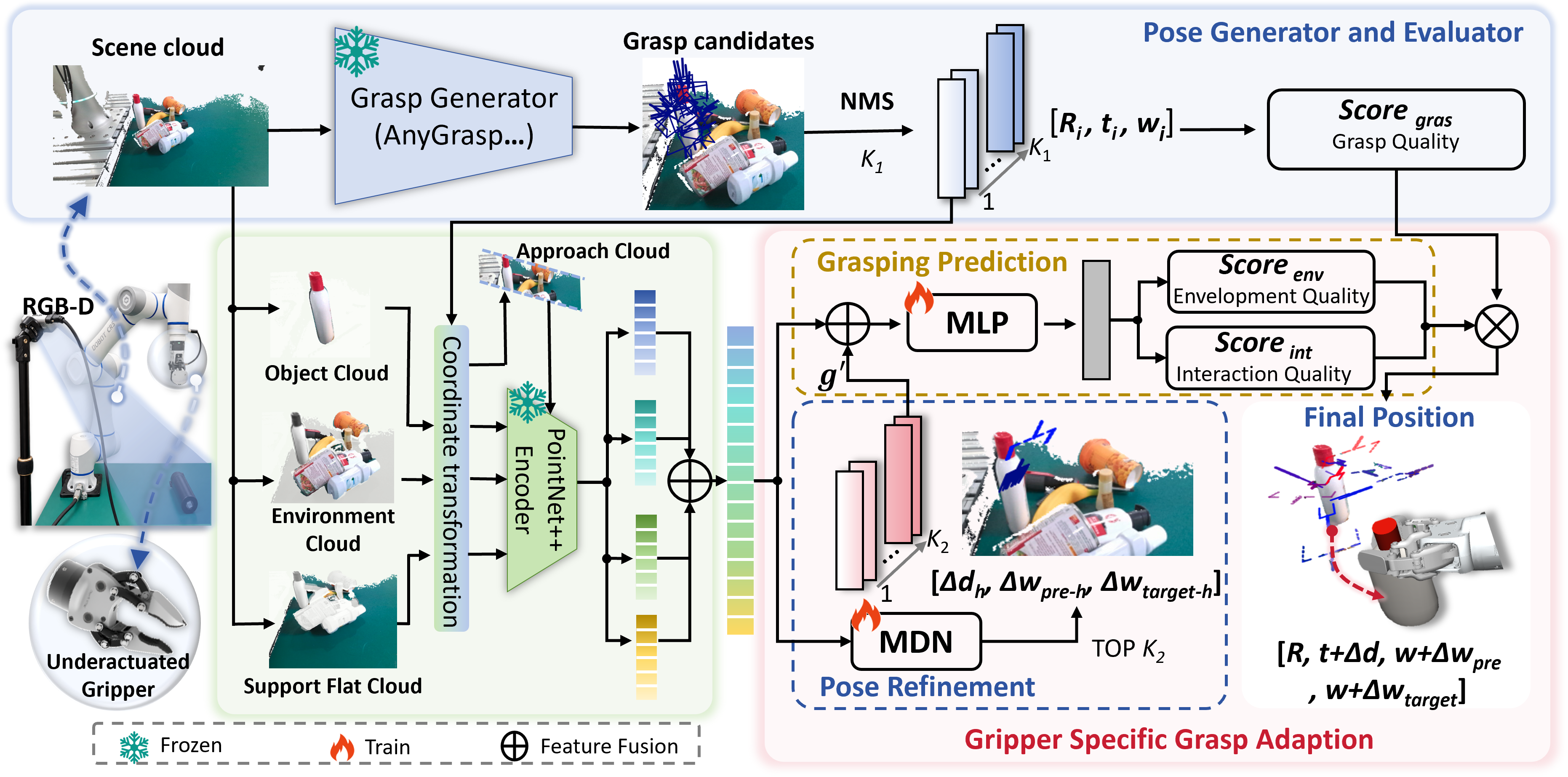
Underactuated grippers can form enveloping grasps through passive compliance, while the terminal pose and single width predicted by generic grasp generators do not fully capture the approach–closure process. Conventional collision filtering also struggles to distinguish harmful interference from acceptable contact. We present UnderGrasp, a post-hoc grasp refinement and evaluation framework for an underactuated gripper that reuses grasp candidates and quality priors from a frozen generator. The model jointly encodes the target, local environment, support surface, and approach-path geometry to propose diverse combinations of insertion depth, pre-grasp width, and target closing width for each candidate. These actions are ranked by combining separately predicted envelopment and interaction quality with upstream priors, balancing grasp feasibility, envelopment, and scene disturbance rather than rejecting all environmental contact. The back end is trained solely on configuration and interaction labels generated by gripper-specific simulations, without real-robot grasp labels. Real-robot experiments with an underactuated gripper show that UnderGrasp improves the overall success rate (SR) and the envelopment rate among successful grasps (ER) from 0.55/0.12 to 0.82/0.55 with AnyGrasp, and from 0.42/0.08 to 0.65/0.36 with GraspNet. In contrast, increasing the fixed insertion depth to 40 mm improves ER to 0.35 but reduces SR to 0.52, supporting the value of adaptive refinement. For trials involving target or environmental contact during approach, the conditional success rates increase from 0.36 to 0.89 and from 0.25 to 0.86, respectively, demonstrating more reliable execution under contact.
From pose to grasp execution
For each grasp candidate, UnderGrasp proposes a set of actions with different combinations of insertion depth, pre-grasp width, and target closing width. Each action receives a score that combines its predicted envelopment and interaction qualities with the generator’s score for the original candidate. The gripper executes the highest-scoring action.
Learning envelopment in simulation
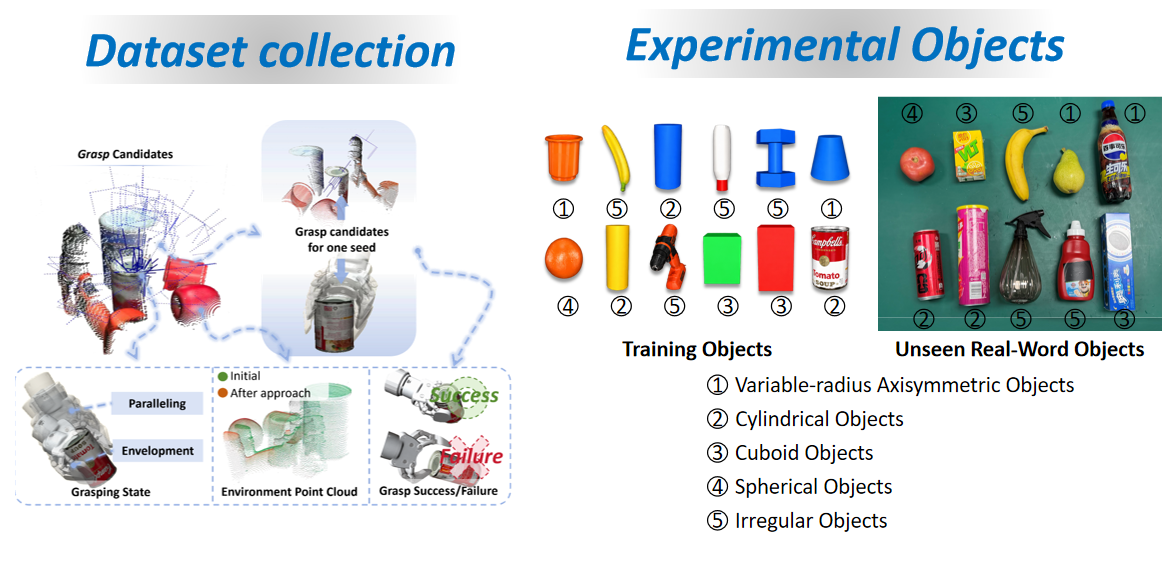
MuJoCo provides finger configurations, scene changes and capture outcomes from 66,560 simulated actions on 12 training objects.
Real-robot grasping
We evaluated each method on 10 objects excluded from UnderGrasp’s back-end training. Each object was tested three times in clean scenes and three times in cluttered scenes, for a total of 60 trials per method. A trial was successful if the robot grasped the target, returned to its initial pose, and held the object for three seconds without dropping it.
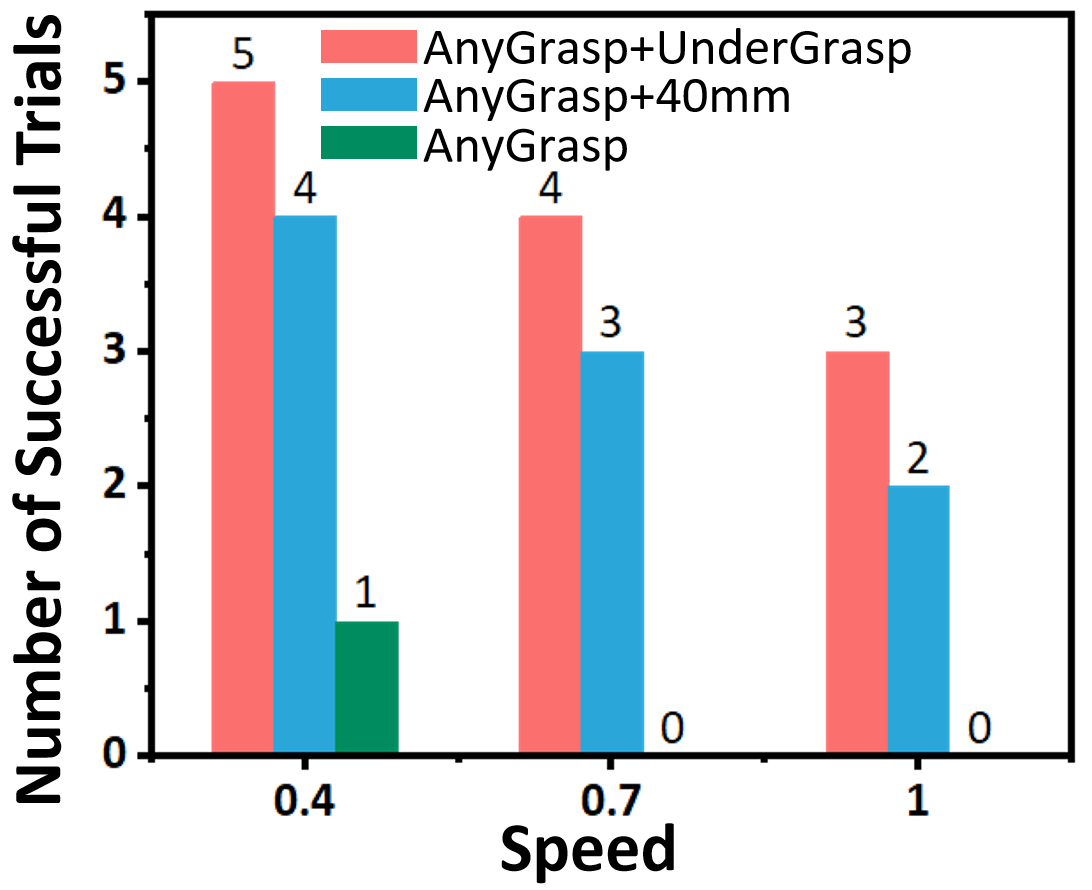
After a successful initial grasp, the robot transported a watering can filled with 500 mL of water at 40%, 70%, or 100% of its maximum speed. For each method, we counted successful transports in five trials at each speed.
Single object performance
| Method | SR | ER |
|---|---|---|
| AnyGrasp | 63% | 11% |
| AnyGrasp + 40 mm insertion | 57% | 47% |
| AnyGrasp + UnderGrasp | 83% | 60% |
| GraspNet | 53% | 13% |
| GraspNet + UnderGrasp | 77% | 35% |
Cluttered scene performance
| Method | SR | ER |
|---|---|---|
| AnyGrasp | 47% | 14% |
| AnyGrasp + 40 mm insertion | 47% | 21% |
| AnyGrasp + UnderGrasp | 80% | 50% |
| GraspNet | 30% | 0% |
| GraspNet + UnderGrasp | 53% | 38% |
Overall performance
| Method | SR | ER |
|---|---|---|
| AnyGrasp | 55% | 12% |
| AnyGrasp + 40 mm insertion | 52% | 35% |
| AnyGrasp + UnderGrasp | 82% | 55% |
| GraspNet | 42% | 8% |
| GraspNet + UnderGrasp | 65% | 36% |
SR is the fraction of all trials that succeed. ER is the fraction of successful grasps that envelop the object.
Transport performance
Citation
@misc{song2026undergrasp,
  title = {UnderGrasp: Envelopment-Oriented Grasp Refinement for an Underactuated Gripper},
  author = {Song, Zhiwen and Liu, Ruidi and Jia, Guanglu and Chen, Zuowei and Wen, Hao and Shi, Qing},
  year = {2026}
}